Product design · Mobile · 2026
Younger: a personal timeline that keeps privacy visible.
Younger explores how one mobile product could help people revisit daily moments, search their history, and manage personal data without turning privacy into fine print.
- Role
- Product designer
- Scope
- Concept, flows, interface system, interactive prototype
- Status
- Concept prototype · not a shipped product
Problem
Personal memories are scattered across photos, messages, location history, health information, and everyday activity. Bringing them together could be useful, but it also creates an immediate trust problem: people need to understand what is stored, where it lives, and what remains under their control.
My responsibility
I structured the product concept, mapped the primary flows, developed the visual language, and built a testable mobile prototype.
- Entry and biometric lock flow
- Day, week, month, and year timeline views
- “Ask Younger” search entry point
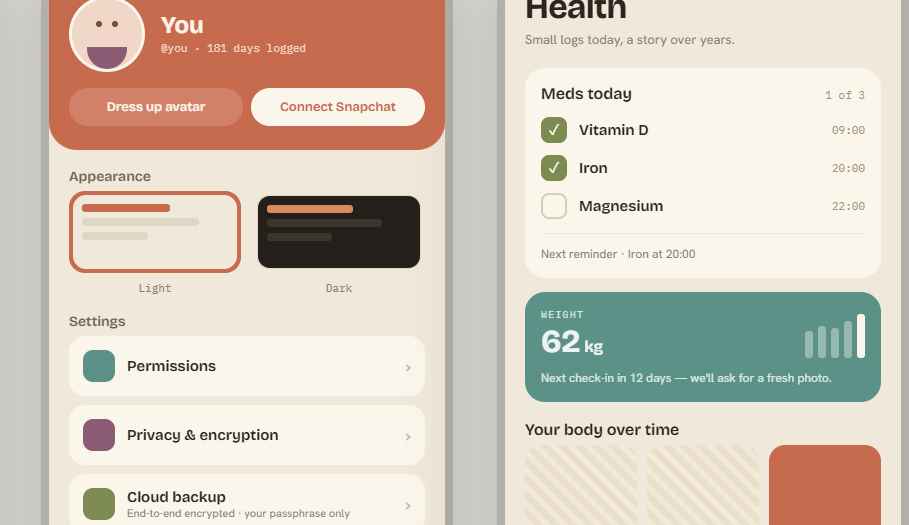
- Profile, wardrobe, appearance, privacy, permissions, and backup settings
Constraints
This is early concept work without production analytics or completed user research. The interface had to communicate a broad feature set without feeling like a dashboard, while privacy needed to remain visible without becoming frightening or repetitive.
Key decisions
Organise memory around time
Day, week, month, and year views give people familiar ways to move through a large personal archive.
Make privacy part of the interface
Encryption, on-device processing, permissions, and backup controls appear at the moments where they help users understand the product.
Use warmth without losing structure
Soft neutrals, terracotta, olive, rounded cards, and clear type hierarchy make sensitive data feel personal rather than clinical.
Final experience
The prototype covers the product’s core navigation and several detailed settings flows. It is designed for discussion and usability testing, not presented as a production release.


Outcome & reflection
The result is a coherent, testable concept spanning the main timeline, search, personalisation, privacy, and backup journeys. No adoption or usability metric is claimed yet.
My next step would be to test the mental model with users: what belongs in a “digital footprint,” which permissions feel acceptable, and whether people understand the difference between local storage and cloud backup.
← Back to selected work